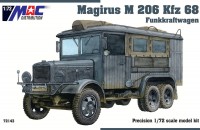
Military vehicles / 1:72 / Funkkraftwagen Magirus M.206 Kfz 68
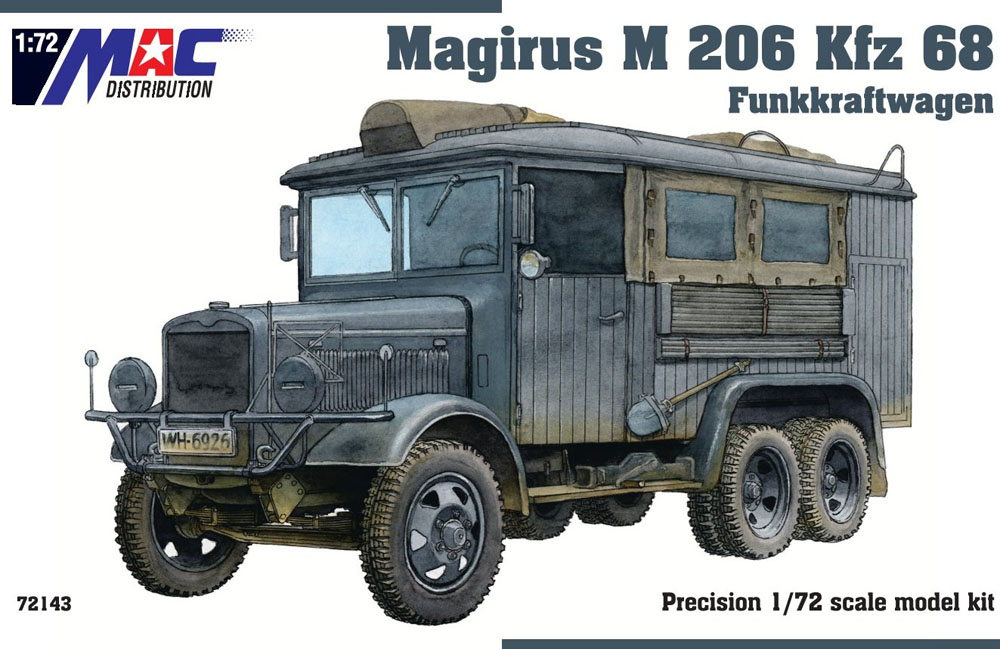
Funkkraftwagen Magirus M.206 Kfz 68
Code: 72143
New
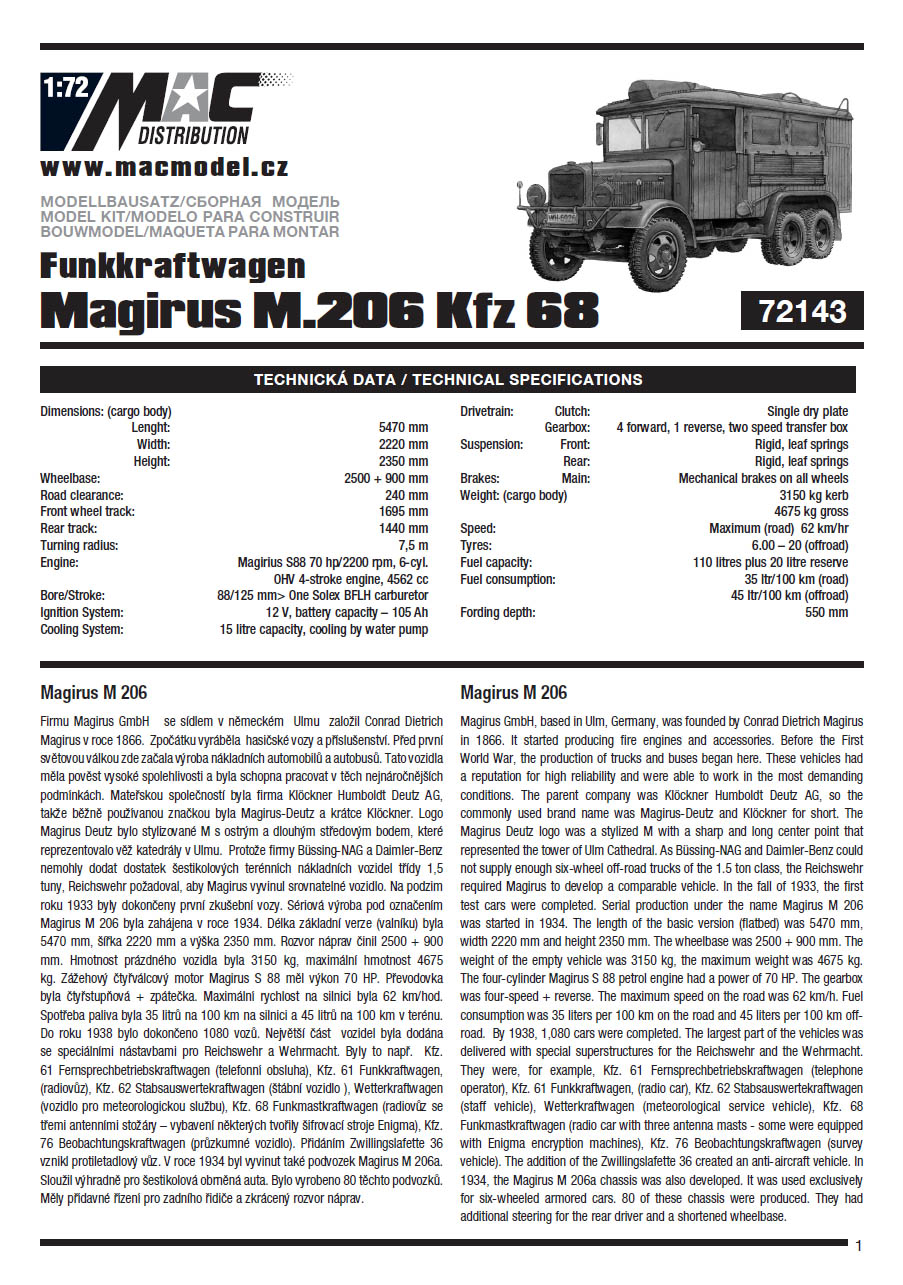
Magirus GmbH, based in Ulm, Germany, was founded by Conrad Dietrich Magirus
in 1866. It started producing fire engines and accessories. Before the First
World War, the production of trucks and buses began here. These vehicles had
a reputation for high reliability and were able to work in the most demanding
conditions. The parent company was Klöckner Humboldt Deutz AG, so the
commonly used brand name was Magirus-Deutz and Klöckner for short. The
Magirus Deutz logo was a stylized M with a sharp and long center point that
represented the tower of Ulm Cathedral. As Büssing-NAG and Daimler-Benz could
not supply enough six-wheel off-road trucks of the 1.5 ton class, the Reichswehr
required Magirus to develop a comparable vehicle. In the fall of 1933, the first
test cars were completed. Serial production under the name Magirus M 206
was started in 1934. The length of the basic version (flatbed) was 5470 mm,
width 2220 mm and height 2350 mm. The wheelbase was 2500 + 900 mm. The
weight of the empty vehicle was 3150 kg, the maximum weight was 4675 kg.
The four-cylinder Magirus S 88 petrol engine had a power of 70 HP. The gearbox
was four-speed + reverse. The maximum speed on the road was 62 km/h. Fuel
consumption was 35 liters per 100 km on the road and 45 liters per 100 km offroad.
By 1938, 1,080 cars were completed. The largest part of the vehicles was
delivered with special superstructures for the Reichswehr and the Wehrmacht.
They were, for example, Kfz. 61 Fernsprechbetriebskraftwagen (telephone
operator), Kfz. 61 Funkkraftwagen, (radio car), Kfz. 62 Stabsauswertekraftwagen
(staff vehicle), Wetterkraftwagen (meteorological service vehicle), Kfz. 68
Funkmastkraftwagen (radio car with three antenna masts - some were equipped
with Enigma encryption machines), Kfz. 76 Beobachtungskraftwagen (survey
vehicle). The addition of the Zwillingslafette 36 created an anti-aircraft vehicle. In
1934, the Magirus M 206a chassis was also developed. It was used exclusively
for six-wheeled armored cars. 80 of these chassis were produced. They had
additional steering for the rear driver and a shortened wheelbase.
Top